
Trying to Make Sense of Tick Senses
Ticks do not have the ability to see in the traditional sense, as many species lack photo receptors. Instead, they rely on other senses, such as detecting carbon dioxide, body heat, and moisture, to find their hosts. But if you check out the anatomical sketch, you will see an “eye” located on the side of the scutum. What’s up with that?
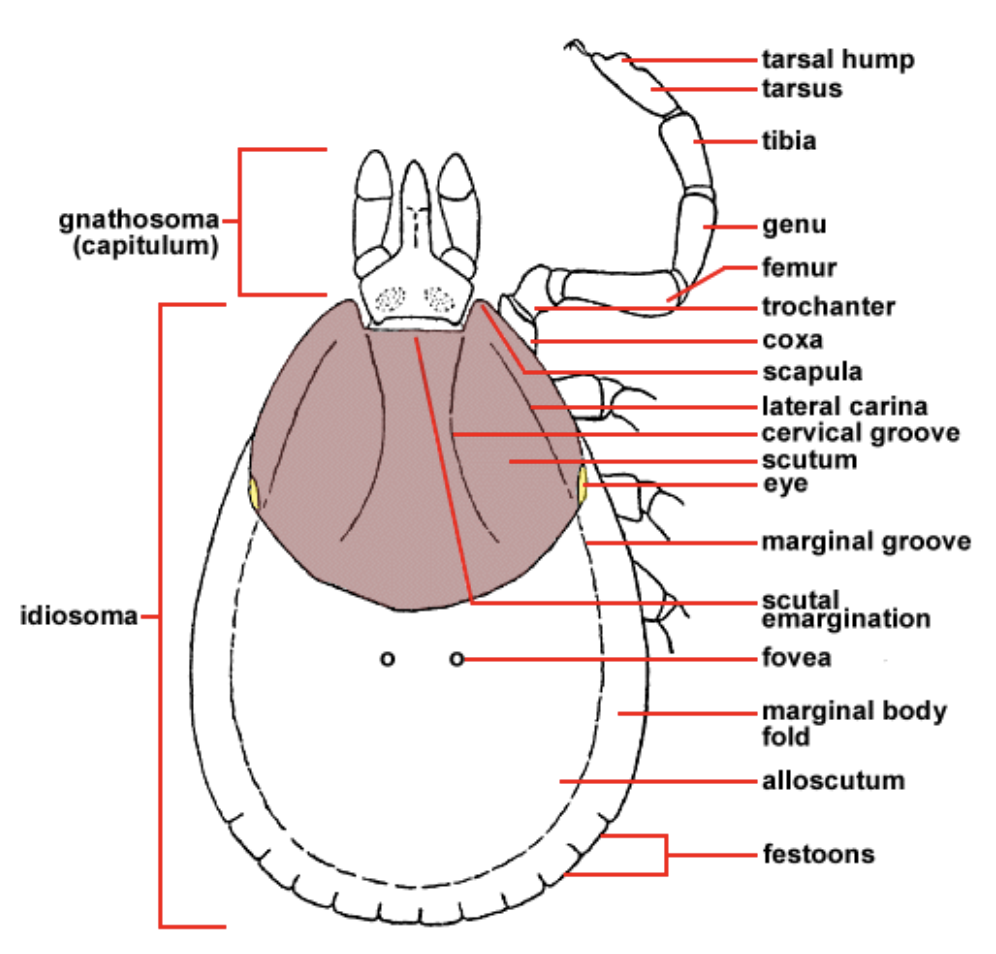
Tick anatomists named these organs “ocelli,” a word derived from the Latin for eye, meaning “little eyes.” Ocelli in ticks primarily function as simple photo-receptors that detect light and movement, helping them navigate their environment. They do not form complex images like compound eyes but are essential for basic visual awareness.
This tick organ is vastly more primitive than compound eyes that detect color, such as those found in insects. Pollinating insects such as many species of bees and butterflies use their color vision to maximize success in foraging. They detect flowers, memorize the colors and patterns of rewarding flowers, and preferentially collect nectars from the flowers in their later visits. Color vision is also critical for increasing efficiency in reproduction.
Don’t forget: Ticks are not insects; they are arachnids, which means they are more closely related to spiders and scorpions. They have eight legs and belong to the order Ixodida.
Apparently evolution saw no need to bless ticks with color vision; their other senses have given them all they needed to grope around their world and thrive and procreate for multi-millions of generations, right down to today.
By the way, another blood-thirsty beast also has “ocelli,” but of another kind and purpose. Notice the “little eyes”: on the back of tigers’ ears, which evolution created to intimidate rivals.

But enough about tigers. Switch back to ticks! How do ticks actually sense and find their prey? Ticks detect carbon dioxide exhaled by potential hosts, signaling their presence.
They sense the heat emitted by warm-blooded animals, helping them identify nearby hosts. Ticks can detect moisture, which is often associated with the presence of a host. Some ticks sense vibrations from movement, indicating that a host is nearby.
Ticks have a unique sensory structure located exclusively on the 1st pairs of legs; the fore-tarsal Haller’s organ, not found in any other animals, presumed to function like insect antennae in chemosensation but morphologically very different.
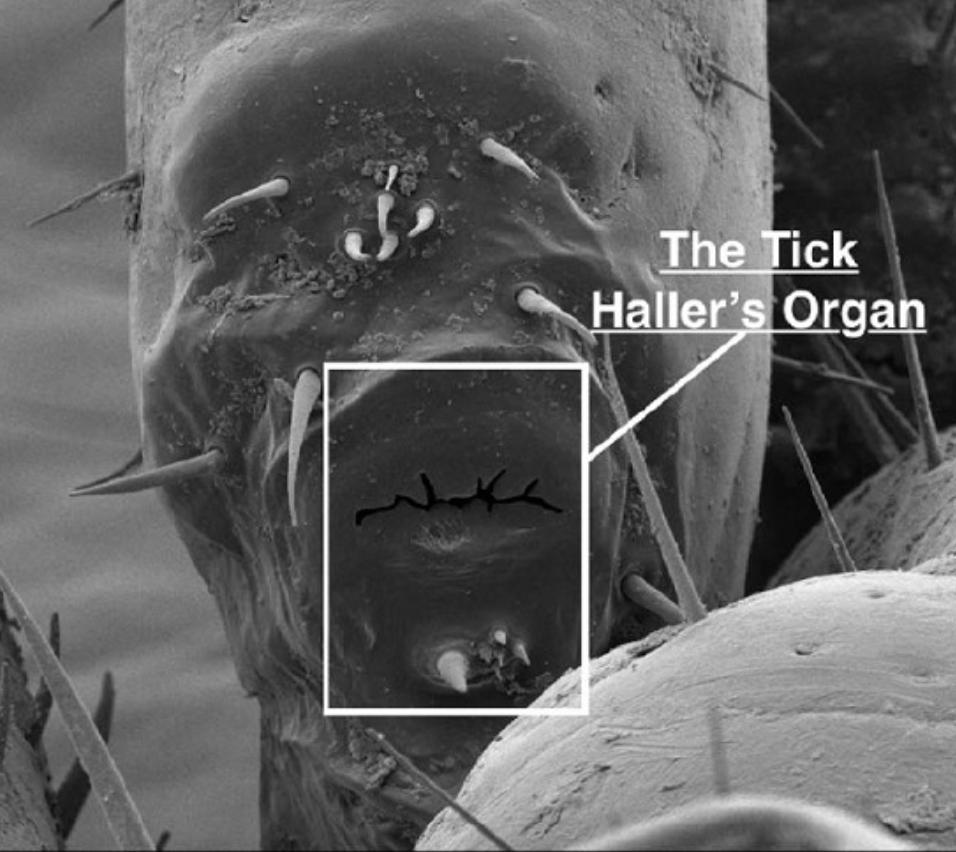
A tick’s main sensory tool is the Haller’s organ, located on the forelegs. The exact sense it powers has proved difficult to pin down; there is strong evidence it is involved in olfaction, but studies have also cast it as a taste, hearing and thermoreception organ. Some researchers have even claimed ticks can detect microwaves, although those data are less convincing. The mechanism of tick chemoreception is unknown.
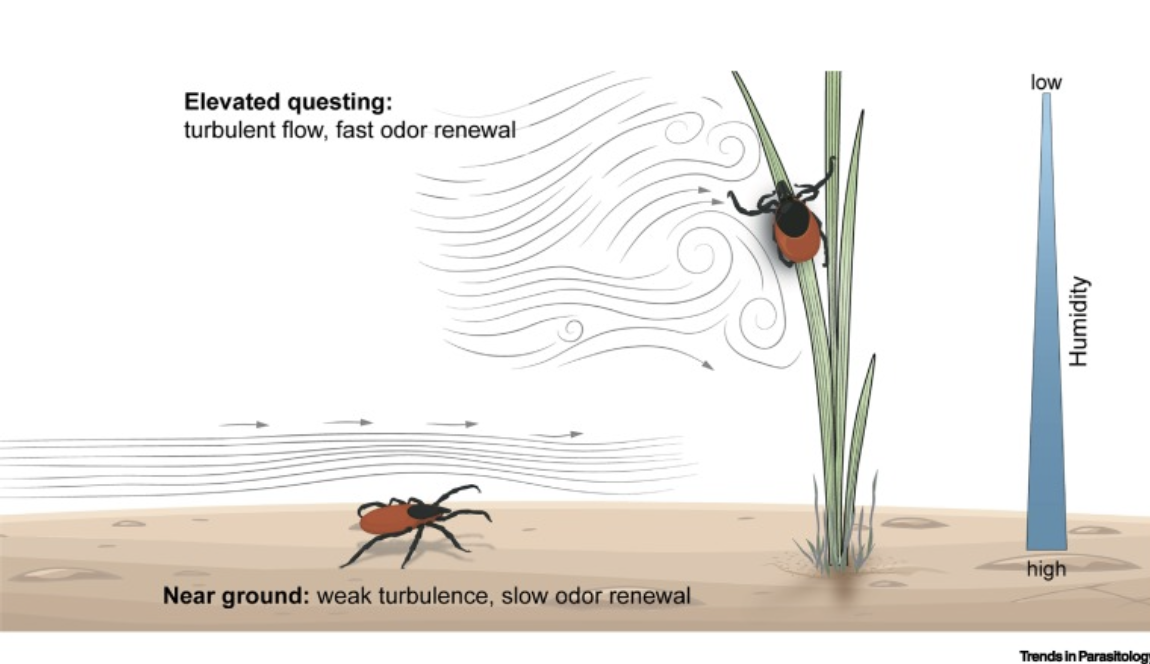
In a fascinating brief article in the March, 2026, issue The Transmitter Dr. Carola Städele of Göttingen University states, ”There are a lot of low-hanging fruits with ticks. For feeding on animals, the most important cue is definitely olfaction—carbon dioxide as an activator, and other host-specific odors. Ticks are super mechanosensory animals. The whole tick body is fullof mechanosensory hairs. When they get exposed to carbon dioxide, they wave their forelegs, which makes more turbulence in the air, so odors reach their olfactory organ better. But the other thing is, they really want to cling onto something. They get this touch compulsion.”*
This illustration demonstrates the dynamics of “questing” - how Haller’s
Organ is aided in detecting odors, when the tick waves the forelegs.
For further information about Haller’s Organ and its functions, check out the two references below, which describe Dr. Städele’s research.
_____________________
Trends in Parasitlolgy
Volume 42, Issue 6, June 2026, Pages 524-537
* Reference: thetransmitter.org
https://www.thetransmitter.org › neuros-ark›neuros-ark-spying-on-the-secret-sensory-world-of-ticks
____________________________________________